
On Deck with Anchor Audio
Share:


Why PA Announcements Get Lost in Gyms, Fields, and Large Event Spaces
Oct 27, 2026
The microphone is on. The speaker is turned up. But halfway across the gym, athletic field, or event space, the announcement is still difficult to understand.
It's a common challenge for anyone responsible for communicating with a large group. Whether you're addressing students during an assembly, directing attendees at a public event, coordinating an outdoor emergency response, or making announcements at a house of worship, getting sound to carry is only part of the equation.
A successful public address (PA) system needs to deliver speech that people can understand, not simply sound that people can hear.
Several factors influence how clearly announcements reach an audience, including distance, background noise, room acoustics, speaker placement, and equipment selection. Understanding these challenges can help you improve communication without simply turning up the volume.
Here's what to look for and how to address the most common causes of unclear PA announcements.
The Problem Isn't Always Volume
When people struggle to hear an announcement, increasing the volume may seem like the obvious solution. Sometimes it helps, but it doesn't address every cause of poor speech intelligibility.
A system that's too quiet may need more output. But a system that's positioned poorly, overwhelmed by background noise, or producing excessive echo can remain difficult to understand even at higher volumes.
Consider a few familiar situations:
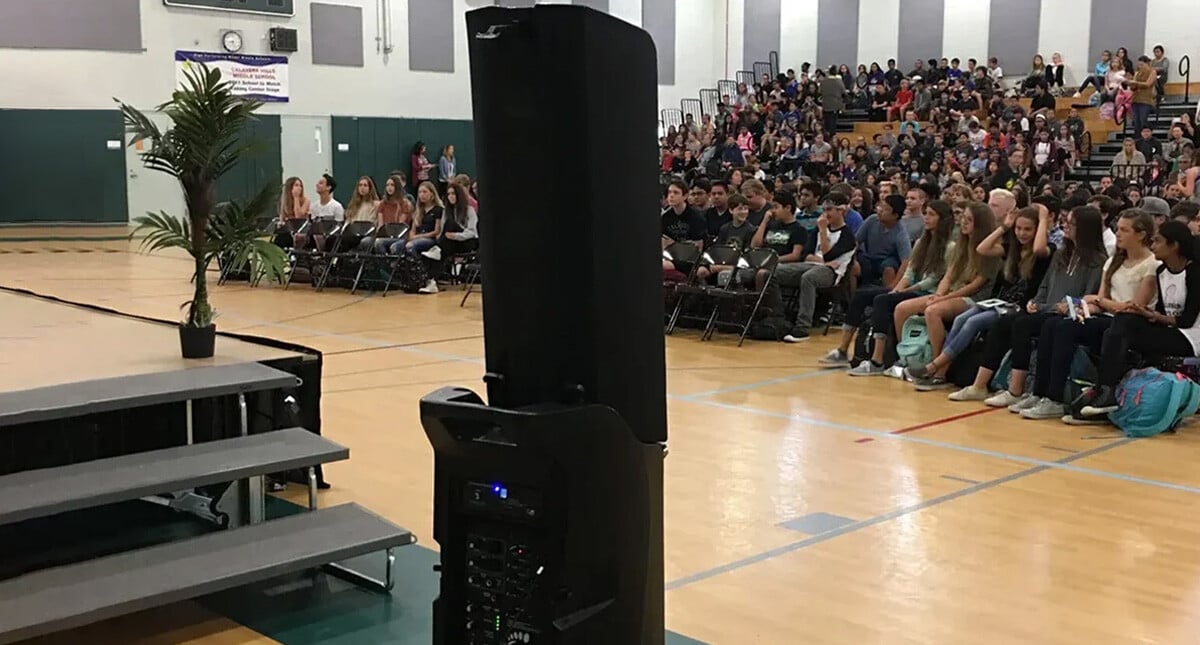
- School gymnasium: A principal makes an announcement, but echoes from the walls and ceiling make the words blend together.
- Outdoor athletic field: Spectators near the speaker hear everything clearly, while people farther down the field struggle to follow instructions.
- Community event: Conversations, music, and crowd noise compete with announcements from the event coordinator.
- Emergency staging area: Staff need to deliver instructions quickly, but the audience is spread across a large outdoor space.
Each scenario presents a different audio challenge. The solution starts with identifying what's interfering with the message.
1. Distance Makes Speech Harder to Hear
Sound spreads as it travels away from its source. As the distance between a speaker and a listener increases, the sound level generally decreases, making announcements harder to hear over background noise.
This is particularly noticeable in outdoor environments, where there are fewer surfaces to reflect sound back toward the audience.
A small portable speaker may work well for a classroom presentation or a group gathered nearby, but it may not provide the coverage required for a large athletic field or an expansive public gathering.
How to improve it:
- Match the PA system's output and design to the size of the intended listening area.
- Consider how far the audience will be from the speaker, not just the total number of people attending.
- Position the speaker so sound is directed toward the audience.
- For especially large areas, evaluate whether multiple appropriately positioned systems are needed.
For example, Anchor Audio's Liberty 3 may suit many school assemblies and medium-to-large gatherings, while the Beacon 3 and Bigfoot 3 are options worth evaluating for larger venues and outdoor events.
The right choice depends on the space, the audience layout, ambient noise, and the level of coverage required.
2. Background Noise Competes With Announcements
A PA system doesn't operate in isolation. It must compete with everything else happening around it.
In a school gym, that might mean bouncing basketballs, student conversations, and whistles. At a public event, it could be traffic, nearby activities, music, or a crowd moving between areas.
Human speech contains important details that help listeners distinguish one word from another. When competing noise masks those details, an announcement may sound loud enough but still be difficult to follow.
This is especially important when communicating instructions that people need to understand the first time.
How to improve it:
- Choose a system with sufficient output for the environment.
- Position speakers closer to the intended listening area when practical.
- Reduce competing audio sources during important announcements whenever possible.
- Test speech clarity under realistic conditions, including typical crowd noise.
- Use a microphone correctly and speak at a consistent, natural pace.
A useful test is to evaluate your system during a real activity rather than only in an empty venue. A speaker that performs well during setup may face very different conditions once the audience arrives.
3. Echo and Reverberation Can Blur Words Together
Indoor environments create a different challenge.
In gymnasiums, cafeterias, auditoriums, and other large rooms, sound can reflect off hard walls, floors, ceilings, and windows. These reflections arrive at the listener at slightly different times, creating echoes or reverberation.
When reflected sound overlaps with the next words being spoken, speech can become muddy and difficult to understand.
This is one reason a PA system that works well in a classroom may not perform as expected in a school gym.
How to improve it:
- Position speakers strategically rather than automatically placing them at the loudest or most convenient location.
- Avoid pointing speakers toward highly reflective surfaces when possible.
- Consider speaker designs that provide appropriate coverage for the room.
- Test the system from multiple listening positions.
- For persistent problems in a permanently used venue, consider an acoustic assessment or professional audio consultation.
Portable PA systems can provide flexible amplification for challenging indoor spaces, but equipment selection and placement still matter. No speaker can eliminate the effects of room acoustics entirely.
4. Speaker Placement Can Make or Break Coverage
Even a capable PA system can deliver uneven results when positioned poorly.
If a speaker is placed too far to one side, aimed away from the audience, or obstructed by equipment and structures, some listeners may receive much less direct sound than others.
Simply increasing the volume to compensate can make the experience unpleasant for people standing nearby without adequately addressing coverage farther away.
Instead, think about where people will be listening.
For a school assembly, the audience may be spread across a gym floor and bleachers. At an outdoor sporting event, listeners may include players, coaches, officials, and spectators along the sidelines. At a community gathering, people may be distributed around entrances, activity areas, and temporary stages.
How to improve it:
- Identify the primary listening areas before setting up.
- Position the speaker to direct sound toward those areas.
- Keep the speaker clear of obstructions where possible.
- Walk the listening area during a sound check.
- If coverage is uneven, consider repositioning the system or using additional compatible speakers.
For larger events, multiple strategically placed systems can provide more consistent coverage than relying on one speaker to serve an entire area from a single location.
5. The PA System May Not Match the Application
Different spaces require different audio capabilities. A compact system designed for a small gathering may not be appropriate for a stadium, just as a high-output system may be unnecessary for a small meeting.
When selecting a portable PA system, consider the full application rather than choosing based on maximum volume alone.
|
Application |
Key consideration |
|
Classrooms and small groups |
Portability, speech clarity, and simple operation |
|
School gyms and cafeterias |
Coverage, speech intelligibility, and reverberation |
|
Athletic fields and outdoor events |
Output, distance, background noise, and battery operation |
|
Houses of worship and community halls |
Coverage across seating areas and clarity for spoken messages |
|
Public safety staging areas |
Rapid deployment, battery power, and clear delivery of instructions |
|
Festivals and large public gatherings |
Audience distribution, multiple listening zones, and scalable coverage |
The system should also fit the way your team works. Equipment that is easy to transport, set up, and operate can be particularly useful when audio needs change from one location to another.
Portable PA systems for different environments
Anchor Audio offers several systems worth evaluating for different communication needs:
- Liberty 3: A portable option for school assemblies, multipurpose spaces, and a variety of indoor and outdoor gatherings.
- Beacon 3: A portable line-array system to consider for larger gatherings and applications requiring broader sound coverage.
- Bigfoot 3: A high-output portable line-array system for large outdoor spaces, athletic fields, and stadium events.
- MegaVox 2: A portable option for outdoor announcements, athletic activities, and mobile communication.
For applications that require additional coverage, compatible Series 3 Pro systems can also be linked wirelessly using AnchorFLEX. This allows users to build a more flexible setup using compatible systems rather than relying on a single speaker for every situation.
Explore Anchor Audio's portable PA systems to find options for your application.
A Simple Sound Check Can Reveal a Lot
Before an event begins, take a few minutes to evaluate the system in the actual space.
Rather than checking only whether the microphone works, test whether people can understand the announcement throughout the intended listening area.
Try this five-step sound check:
1. Check the setup location
Confirm that the speaker is stable, unobstructed, and directed toward the intended audience.
2. Test the microphone
Speak at a natural volume and verify that the microphone and any wireless connections operate correctly.
3. Listen from different locations
Have someone listen near the speaker, in the middle of the audience, and at the farthest intended listening point.
4. Check clarity, not just loudness
Use a short spoken message to check whether the words are understandable. Listen for echo, distortion, and areas where the sound becomes difficult to follow.
5. Make adjustments before the audience arrives
Reposition the speaker, adjust levels, or reassess coverage if needed. For important announcements, establish a backup communication method as part of event planning.
For emergency preparedness, this check should be part of a broader communication plan. Portable PA equipment can supplement installed notification systems and help staff communicate in designated areas, but it should not replace required emergency alert systems or established safety procedures.
Clear Communication Matters Beyond the Classroom
The challenges that affect announcements in a school gym or on an athletic field also appear in many other environments.
Government agencies may need to communicate during outdoor public meetings. Public safety teams may need portable audio at temporary staging locations. Houses of worship may host gatherings in multipurpose spaces, while live event organizers may need to deliver instructions across changing venues.
In each case, the goal is the same: make sure the intended audience can understand the message.
Choosing an appropriate PA system, placing it carefully, testing it under realistic conditions, and planning for the environment can all help improve speech intelligibility.
Anchor Audio's portable PA systems are designed for applications where mobility and amplified communication are important. With options for smaller gatherings, indoor events, and large outdoor spaces, organizations can evaluate solutions based on their specific coverage needs.
Need a better audio solution for your next event? Explore Anchor Audio's portable PA systems or connect with an authorized dealer to discuss the right setup for your environment.