-2.png?width=184&height=100&name=AnchorAudio-Logo-bold-R%20(1)-2.png "Anchor Audio Logo")
On Deck with Anchor Audio
Share:




Hear Every Voice: Creating More Accessible Worship Spaces with Assistive Listening
Aug 25, 2026
A meaningful worship experience depends on being able to hear and understand the message.
For many members of a congregation, however, hearing clearly can become increasingly difficult. Age-related hearing loss, room acoustics, background noise, distance from the speaker, and other factors can make it challenging to follow a sermon, presentation, prayer, or musical performance, even when the main sound system is working properly.
That's why accessibility should be an important part of a house of worship's audio strategy.
An assistive listening system for churches and houses of worship can provide additional support for individuals who are hard of hearing, helping them more clearly hear the audio being presented without requiring the entire room to be louder.
Because worship is about bringing people together, everyone should have the opportunity to participate.
Hearing Clearly Isn't Just About Volume
When someone is having difficulty hearing a speaker, the instinct may be to turn up the main PA system.
But louder doesn't always mean clearer.
In a large worship space, sound can travel a significant distance between the speaker and the listener. Room acoustics, reverberation, background noise, and other factors can make speech difficult to understand.
Simply increasing the volume may not solve the underlying problem.
Assistive listening takes a different approach.
Rather than relying solely on the sound traveling through the room, an assistive listening system provides an audio signal directly to the individual listener through a personal receiver and listening device.
This can help someone focus on the presenter's voice and better understand what's being said even when the acoustics of the room make listening difficult.
Who Can Benefit from Assistive Listening?
Assistive listening isn't limited to one particular age group.
It can benefit anyone who has difficulty hearing or understanding amplified speech in a worship environment.
That may include:
- Older members of the congregation
- Individuals with hearing loss
- People who struggle with speech clarity in large rooms
- Visitors who may not be familiar with the acoustics of the space
- Congregants who have difficulty hearing from certain seating areas
- Individuals who benefit from additional volume or a more direct audio signal
For some people, having access to assistive listening can make the difference between simply attending a service and being able to fully participate in it.
Where Can Assistive Listening Be Used?
One of the benefits of a portable assistive listening system is its versatility.
It can support audio in a variety of spaces and applications throughout a house of worship.
Main Worship Space
The sanctuary or main worship space is perhaps the most obvious application.
Assistive listening can help members hear:
- Sermons
- Worship leaders
- Guest speakers
- Scripture readings
- Announcements
- Religious education
- Special presentations
For a congregation with members who are hard of hearing, making assistive listening available alongside the main church sound system can create a more inclusive worship environment.
Fellowship & Community Rooms
Worship doesn't happen exclusively in the main sanctuary.
Bible studies, religious education, community meetings, guest presentations, and fellowship events may take place in other rooms throughout the facility.
Portable assistive listening equipment can provide additional flexibility when these events require accessible audio.
Overflow Areas
Special services and holidays can bring larger-than-usual crowds.
When additional seating is needed in another room or area, providing accessible audio there can help ensure that people who are hard of hearing aren't left without the support they need.
Community Outreach Events
Accessibility shouldn't disappear when worship moves outside the building.
Community gatherings, outdoor services, fundraisers, and outreach events can also present challenges for people who have difficulty hearing.
When paired with a portable PA system, assistive listening can help extend accessibility beyond the traditional worship space.
How Assistive Listening Works with Your Existing PA System
An assistive listening system doesn't necessarily replace your existing church PA system or house of worship sound system.
Instead, it can work alongside it.
The audio from the worship service or presentation is fed into the assistive listening transmitter. Individual users then receive that audio through a personal receiver and listening device.
This creates a more direct listening experience for the individual without requiring the entire congregation to listen at a higher volume.
Anchor Audio's Assistive Listening system uses 100-channel UHF diversity wireless technology, is expandable for an unlimited number of users, and provides a range of up to 300 feet line of sight.
The system is also designed to be easy to set up and operate, which is especially important for houses of worship that rely on volunteers to manage audio equipment.
Accessibility Doesn't Have to Be Complicated
Audio equipment can sometimes feel intimidating, especially when volunteers (not full-time audio technicians) are responsible for setting it up.
That's why simplicity matters.
An assistive listening system should be straightforward enough that staff or volunteers can:
- Set up the transmitter
- Connect it to the audio source
- Provide receivers to individuals who need them
- Help users get comfortable with their listening devices
- Collect and store the equipment after the event
Anchor Audio's system is designed for easy setup and operation, making it practical for houses of worship where audio responsibilities may rotate among staff and volunteers.
Make Assistive Listening Part of Your Welcome
One of the most important considerations isn't simply having an assistive listening system.
It's making sure people know it's available.
Consider incorporating assistive listening into your normal hospitality process.
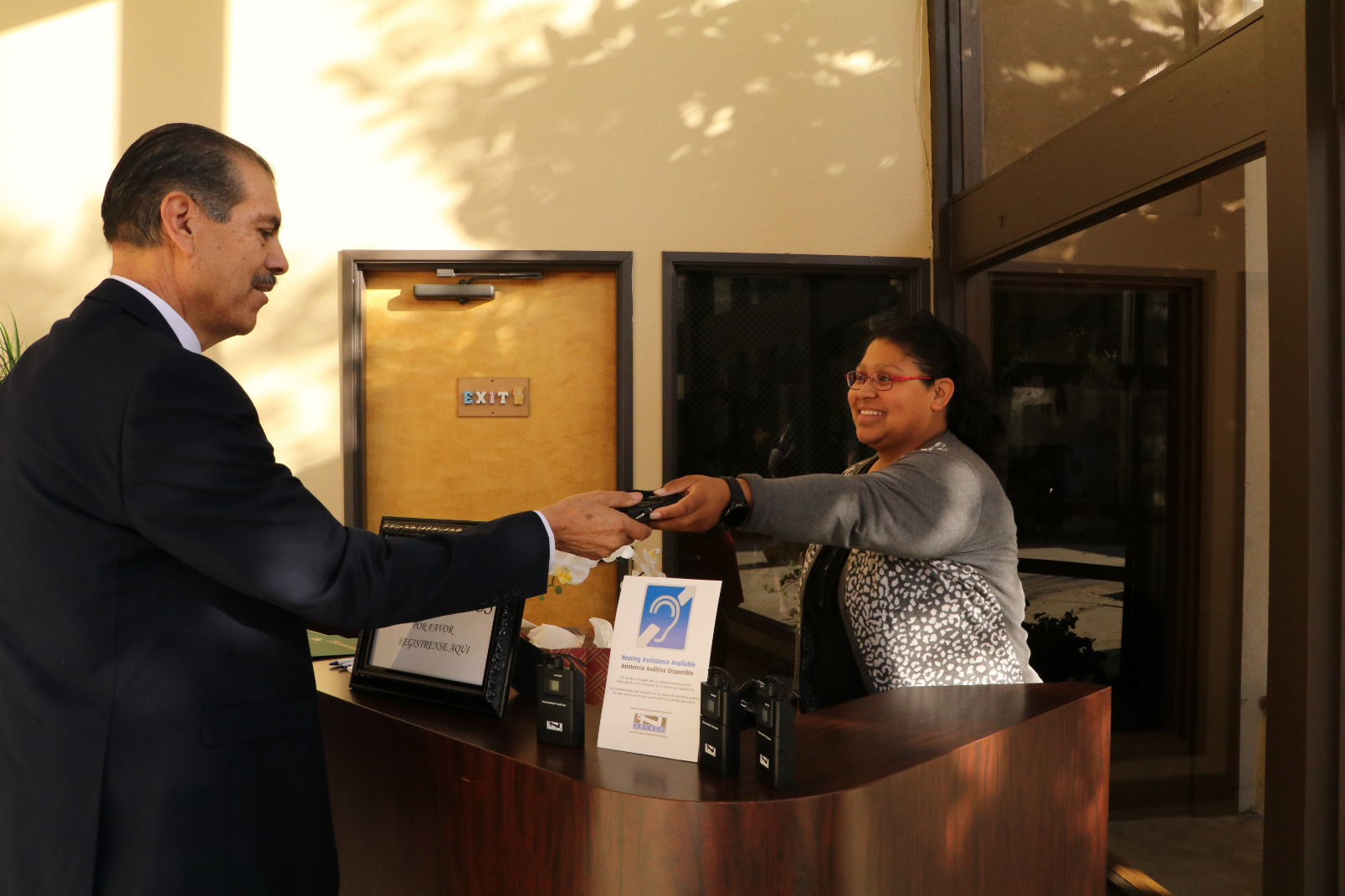
For example, a greeter or welcome team member could let visitors and congregation members know that assistive listening devices are available if needed.
You might also:
- Clearly identify where devices can be picked up
- Train greeters and volunteers on basic operation
- Include availability information in service programs
- Add signage near entrances
- Keep receivers charged or stocked with fresh batteries
- Make the process discreet and easy
The goal is to make asking for assistance feel as normal as asking where the restrooms are or where to find the children's room.
Accessibility is part of hospitality.
A Real-World Example: Helping a Congregation Hear More Clearly
The value of assistive listening can be especially apparent in larger worship spaces.
My Father's House Apostolic Christian Church in Escondido, California, serves up to 800 regular members during Sunday services. The church found that members seated farther from the stage had difficulty hearing, while individuals with hearing difficulties struggled regardless of where they sat. After implementing Anchor Audio Assistive Listening devices, the church began offering devices to members who needed them as they arrived for services.
It's a good example of how accessibility can become part of the normal worship experience rather than an afterthought.
Pair Accessibility with a Flexible Portable PA System
Assistive listening doesn't have to exist separately from the rest of your portable audio strategy.
Houses of worship can combine accessible audio with the same flexible PA systems they use throughout their facilities.
For example:
Main Worship Space
Bigfoot 3 Pro provides sound reinforcement for the congregation.
Youth Center
Liberty 3 Pro supports youth programs and smaller gatherings.
Reception Area
Beacon 3 Pro provides audio for welcome events and community gatherings.
Members Who Need Additional Listening Support
Assistive Listening provides a more direct audio signal to individual listeners.
And when those Series 3 Pro systems are linked with AnchorFLEX for a large outdoor service or community event, accessibility can remain part of the event planning rather than something that's only considered indoors.
Accessibility Is Part of Worship Outreach
Worship outreach is about more than inviting people through the doors.
It's about creating an environment where people feel welcomed, included, and able to participate.
For someone who struggles to hear, being able to clearly follow a sermon, prayer, presentation, or song can have a significant impact on their experience.
A portable assistive listening system for churches and houses of worship is one practical way to help remove that barrier.
Because everyone deserves the opportunity to hear the message.
And everyone deserves the opportunity to be part of the conversation.
Create a More Accessible Worship Experience
Whether you're upgrading your main worship space, preparing for larger community events, or simply looking for a better way to support members who are hard of hearing, assistive listening can be an important part of your audio strategy.
Explore Anchor Audio's Assistive Listening solutions and discover how you can make your house of worship more accessible.